

Got a battery quote sitting in your inbox? Then you have probably heard the same line from every installer: “The rebate drops on 1 January.”
It does. But it is not ending, it is not a cliff, and for most households it is not a reason to sign something this week. Here is what actually changes, what it costs you in dollars, and how to decide without being rushed.
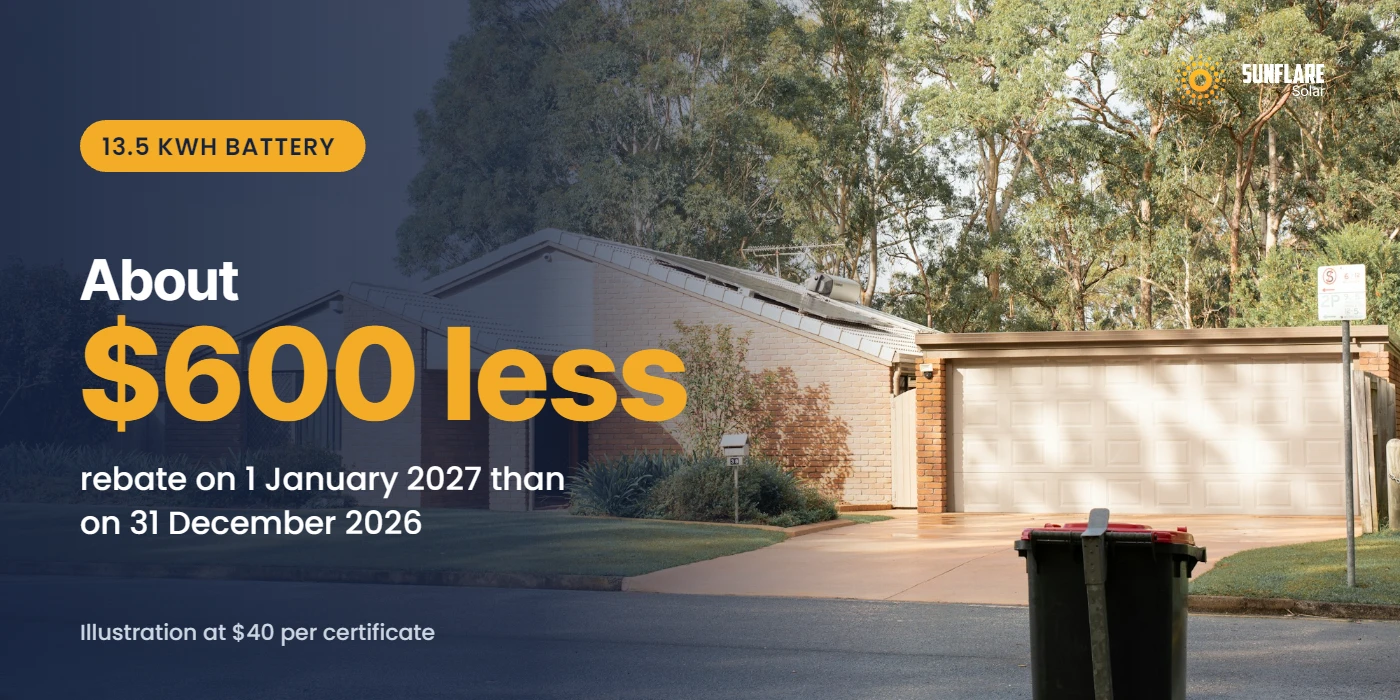
The short answer: from 1 January 2027, the same battery earns about 16% fewer government certificates. For a 13.5 kWh battery, that is roughly $600 less discount. The rebate itself carries on until the end of 2030.
What actually changes on 1 January 2027?
The Cheaper Home Batteries Program takes money off your battery through small-scale technology certificates (STCs). Your installer claims the certificates and takes their value off your price. You do not apply for anything.
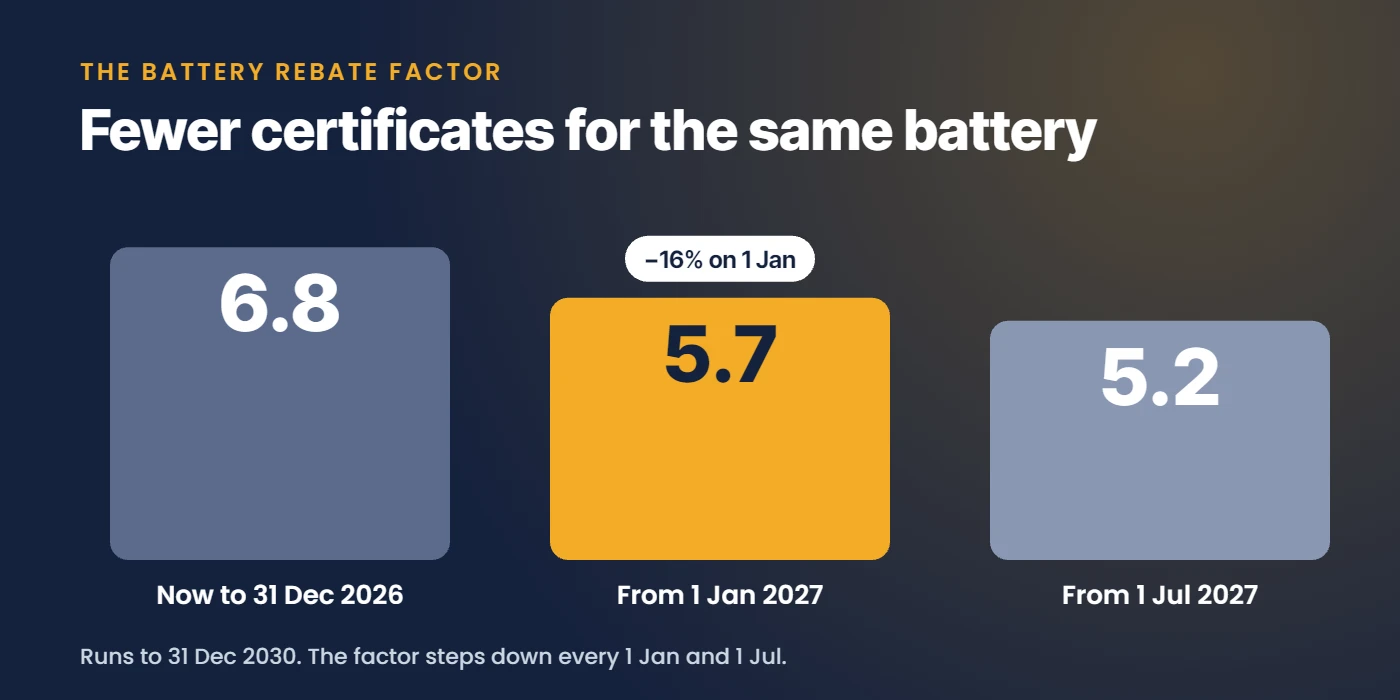
How many certificates you get depends on a factor that shrinks over time. For batteries, it drops twice a year, on 1 January and 1 July. Published schedules show it going from 6.8 today to 5.7 on 1 January 2027, then to 5.2 on 1 July 2027.
Same battery. Same installer. Fewer certificates, so a smaller discount.
How is the battery rebate worked out?
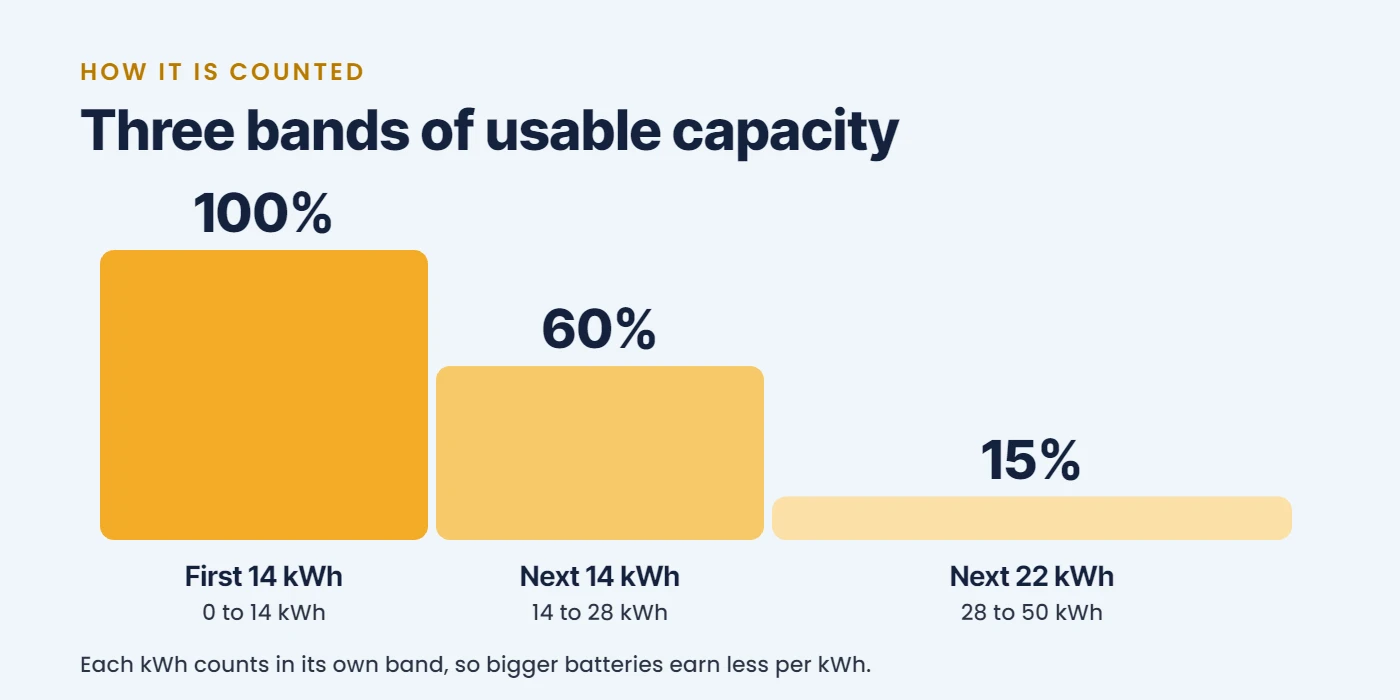
It is based on the usable capacity of the battery, not the brand or the price tag. Since 1 May 2026, the Clean Energy Regulator counts that capacity in three bands:
- The first 14 kWh earns the full factor.
- The next 14 kWh (14 to 28 kWh) earns 60% of it.
- The next 22 kWh (28 to 50 kWh) earns 15% of it.
Each kWh is counted in its own band. A 20 kWh battery gets the full rate on its first 14 kWh and 60% on the other 6. That is why very large batteries get a smaller rebate per kWh than a typical home battery.
How much will the rebate drop?
Here is what that looks like for three common sizes. Certificates are rounded down to whole numbers. The dollar amounts assume $40 per certificate, which is an illustration only. The real value moves with the market and is set by your installer.
| Usable battery size | Now to 31 Dec 2026 | 1 Jan to 30 Jun 2027 | 1 Jul to 31 Dec 2027 |
|---|---|---|---|
| 10 kWh | 68 certificates, about $2,720 | 57 certificates, about $2,280 | 52 certificates, about $2,080 |
| 13.5 kWh | 91 certificates, about $3,640 | 76 certificates, about $3,040 | 70 certificates, about $2,800 |
| 20 kWh | 119 certificates, about $4,760 | 100 certificates, about $4,000 | 91 certificates, about $3,640 |
So the 1 January step costs a 10 kWh battery about $440, a 13.5 kWh battery about $600, and a 20 kWh battery about $760.
Want to check it yourself? Take 13.5 kWh and multiply by the factor: 13.5 × 6.8 = 91.8, which rounds down to 91 certificates. At 5.7 it is 76. The gap is 15 certificates. Multiply that by the certificate value on your quote and you have the cost of waiting for that battery.
Does the rebate end on 1 January 2027?
No. This is the part that gets lost in sales pitches. 1 January is a step down, not an end date. Eligible installs keep earning the rebate until 31 December 2030, with a smaller step each 1 January and 1 July.
If someone tells you it ends on any other date, ask them to show you where that date is published.
The detail that catches people out: install date, not signing date
The rebate depends on the day the battery is installed, not the day you sign. The Clean Energy Regulator says so directly.
In practice, a battery you sign for in December but that goes in on 5 January earns the January amount. So if an installer promises you a December install, get that date in writing. The regulator has warned retailers not to promise installs before a cut-off unless they are certain they can finish on time.

Should you rush to install before 1 January?
Not automatically. The drop is real, but a rushed job can cost you more than the step-down does. Ask yourself three questions:
- Is the gap big enough to matter? Look at the table. For many households it is a few hundred dollars, not thousands.
- Is your home ready? If you need an inverter change or switchboard work, a December install may not be realistic, and a battery that is installed properly beats one that is installed fast.
- Do you trust the quote and the installer? A fair price from someone you are comfortable with is worth more than a deadline.
If the numbers and the timing line up, going ahead before the step is reasonable. If they do not, the next step on 1 July is smaller than this one, so waiting costs less than people expect. It is your call, made with the numbers in front of you.
How to spot a fake rebate deadline
Because the step-down is real, some sellers use it to hurry people along. Be careful if you hear any of these:
- A deadline that is not 1 January or 1 July, or a claim that the rebate ends completely.
- “You will lose thousands” with no working shown.
- Pressure to sign today, or at your front door.
- A December install date that is promised out loud but not written down.
A good installer explains the step-down, shows you the certificate count, and lets you take the quote home. Our guide on how to compare solar quotes shows what a clear quote looks like.
What your battery quote should show
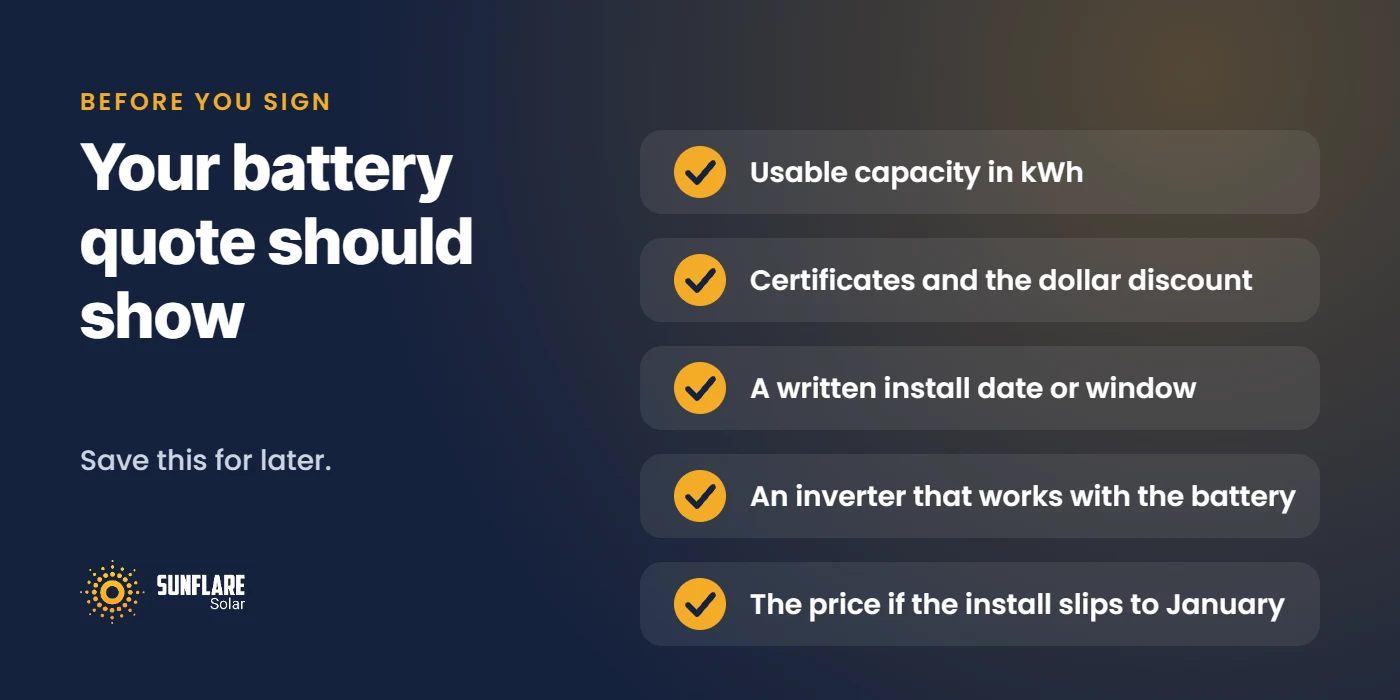
Before you sign, check that the quote spells out:
- The usable capacity in kWh, not just the headline size.
- The number of certificates and the dollar discount taken off the price.
- A written install date, or at least a written install window.
- Which inverter is used and that it works with the battery. Our guide to hybrid solar inverters explains why that matters.
- What happens to the price if the install slips into the new year.
Still deciding whether a battery suits your home at all? Start with solar batteries explained. To see what happens on the day, read our solar panel installation process guide.
What about solar panels and state rebates?
Solar panels have their own certificate scheme. It steps down once a year, on 1 January, and panels stay eligible until 31 December 2030. The install-date rule is the same. If you are adding panels and a battery together, ask for both discounts as separate lines so you can see what each one is worth.
State programs are separate from the federal rebate, and their dates and rules differ. We keep these guides up to date: Victoria, Tasmania and Western Australia. If you are in Hobart or Geelong, our local pages explain what we install in your area.
Frequently asked questions
No. It steps down on 1 January 2027 and again on 1 July 2027. The program runs for eligible installs until 31 December 2030.
The factor falls from 6.8 to 5.7, about 16% fewer certificates for the same battery. At an illustrative $40 per certificate, that is roughly $440 for a 10 kWh battery and $600 for a 13.5 kWh battery.
The install date. A contract signed in December still earns the January amount if the battery is installed in January, so get any December install date in writing.
The factor applies in bands of usable capacity: the full rate for the first 14 kWh, 60% from 14 to 28 kWh, and 15% from 28 to 50 kWh. Larger batteries therefore earn much less per kWh.
It is the part of the battery you can actually draw on, which is often a little lower than the headline size. The rebate is based on usable capacity, so check it on the spec sheet and on your quote.
It depends on your timing and your system. The 1 July step is smaller than the 1 January step for the sizes in our table, but waiting also means going longer without the savings a battery can give you. Compare the dollars on your own quote before deciding.
Get a clear battery quote from Sunflare Solar
If you want to know what your battery would cost before and after 1 January, we can price it both ways. You get the usable capacity, the certificate count and the install window in writing, so you can compare us with anyone.
Book a free solar and battery assessment
Rebate figures are based on published schedules and the Clean Energy Regulator’s tier rules, checked on 14 November 2026. Dollar amounts use an assumed certificate price and are illustrations, not a quote. Program details can change, so confirm your own figures with your installer and the Clean Energy Regulator.