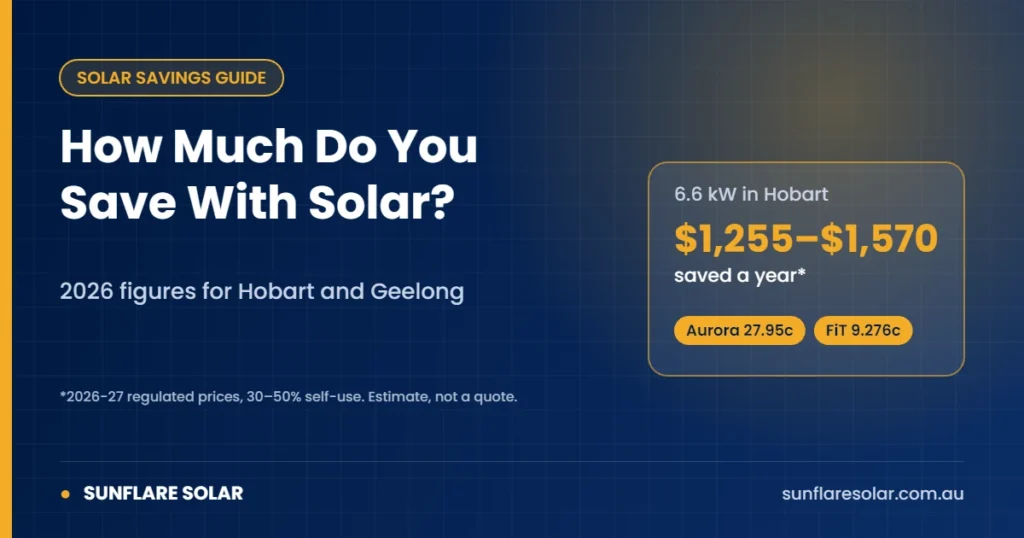
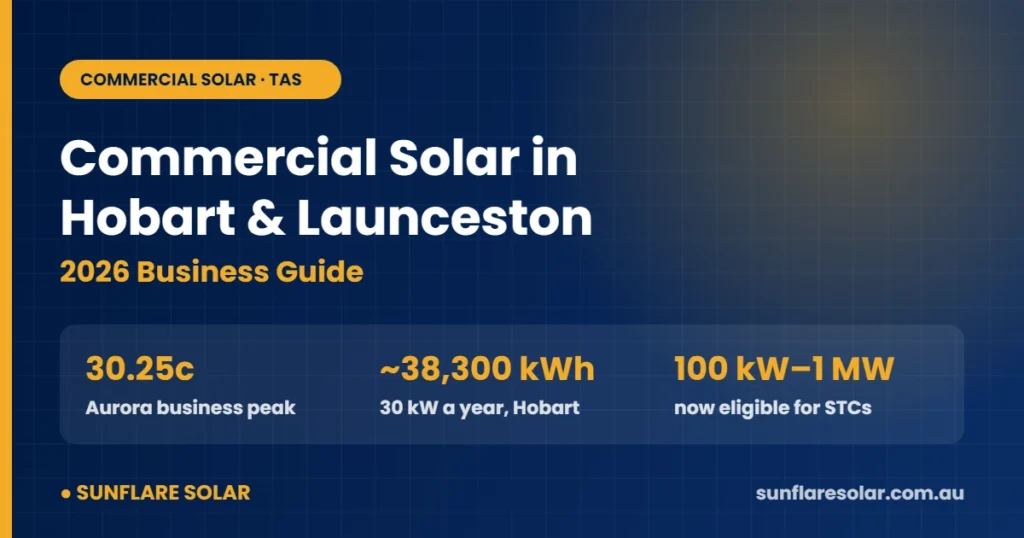
The short answer: commercial solar suits most Hobart and Launceston businesses that use power during the day, because every kilowatt-hour the panels supply replaces power bought at up to 30.25c on Aurora Energy’s 2026-27 business time-of-use peak rate. A 30 kW system in Hobart produces about 38,300 kWh a year, worth roughly $9,000 to $10,400 a year on that rate when most of it is used on site. Systems up to 100 kW get the federal STC discount upfront, and from 1 October 2026 systems from 100 kW to 1 MW can claim it too.
This guide covers how much a business system produces in southern and northern Tasmania, what it is worth on 2026-27 business tariffs, the rebates and tax rules that apply, and what to check before you sign. For our commercial services and system sizes, see commercial solar and commercial system sizes.
Why commercial solar works well in Tasmania
- Daytime use matches solar output. Offices, workshops, shops, cool rooms and farms use most of their power between 7am and 5pm, when the panels are producing.
- Business peak rates cover the working day. Aurora’s Business Time of Use tariff charges its peak rate from 7am to 10pm on weekdays, so solar replaces the most expensive power.
- Exported power earns little. The regulated minimum feed-in tariff of 9.276c only applies to smaller systems (up to 10 kW single-phase or 30 kW three-phase), so a business system should be sized to be used on site.
How much a business system produces
The Clean Energy Council’s guide figure for Hobart is about 3.5 kWh per day for each kW of panels, averaged over the year. We use the same figure for Launceston to stay conservative. Winter output is much lower than the average and summer output much higher.
| System size | Average per day | Per year |
|---|---|---|
| 15 kW | about 53 kWh | about 19,200 kWh |
| 30 kW | about 105 kWh | about 38,300 kWh |
| 50 kW | about 175 kWh | about 63,900 kWh |
| 100 kW | about 350 kWh | about 127,750 kWh |
What it is worth on 2026-27 business tariffs
These are Aurora Energy’s regulated business prices from 1 July 2026:
| Aurora business tariff | Rate |
|---|---|
| Business Time of Use: peak (weekdays 7am to 10pm) | 30.25c per kWh |
| Business Time of Use: shoulder (weekends 7am to 10pm) | 21.86c per kWh |
| Business Time of Use: off-peak (10pm to 7am) | 12.79c per kWh |
| General Business (Tariff 22, closed to new connections) | 32.75c for the first 500 kWh a quarter, then 27.04c |
| Business Single Rate contract | 27.5c per kWh |
Worked example: 30 kW in Hobart
Assumptions: 38,325 kWh a year, Business Time of Use peak rate 30.25c for power used on site, and the 9.276c feed-in tariff for exports.
| Share used on site | Saved on the bill | Feed-in credits | Total a year |
|---|---|---|---|
| 70% | about $8,115 | about $1,067 | about $9,180 |
| 85% | about $9,854 | about $533 | about $10,390 |
For a 100 kW system using 80% of its output on site at the same peak rate, the saving is about $30,900 a year before any export credit. Real results depend on your load profile, roof, shading and the tariff on your account, which is why we size business systems from your interval meter data, not a rule of thumb.
Rebates and tax: what applies to businesses
Small-scale technology certificates (up to 100 kW)
Business systems up to 100 kW create STCs, which the installer takes off the price upfront. In Tasmania (zone 4) a 30 kW system installed in 2026 creates about 177 certificates and a 100 kW system about 592. Certificates have traded close to the $40 clearing house price, so that is roughly $7,000 and $23,700 respectively. The number of certificates falls each year until the scheme ends in 2030.
New: mid-scale systems from 100 kW to 1 MW
Until recently, systems over 100 kW could only earn large-scale generation certificates over time. Under changes that apply to systems installed from 1 October 2026, solar between 100 kW and 1 MW can now choose upfront STCs with a fixed 5-year deeming period, or register as a power station and earn LGCs instead. Mid-scale systems need extra paperwork, including an as-built structural engineering report, an electrical single line diagram and a connection agreement. Applications opened in the REC Registry in November 2026.
Instant asset write-off
From 1 July 2026 the $20,000 instant asset write-off for small businesses (turnover under $10 million) is permanent. It applies per asset costing less than $20,000; most commercial solar systems cost more than that and are depreciated under the small business rules instead. Ask your accountant how a system would be treated for your business before you rely on any tax benefit.
Batteries for business
A battery helps when a business uses a lot of power after the panels stop, for example evening trading, refrigeration or after-hours equipment. Batteries from 5 kWh to 100 kWh can create STCs under the Cheaper Home Batteries program, with certificates issued for the first 50 kWh, and the rebate rate per kWh drops on 1 January 2027. See what changes on 1 January 2027.
Network connection in Tasmania
Every system needs approval from TasNetworks before it is connected. Larger systems, three-phase connections and anything over the standard export limits can take longer and may need export limiting. A good installer handles the application, the compliance certificate and the meter change, and tells you upfront if export limits apply.
What to check on a commercial solar quote
- System size based on your interval data, with expected yearly output.
- Expected share of output used on site, and the tariff the saving is calculated on.
- STC or LGC treatment, and the dollar discount shown on the quote.
- Panel, inverter and mounting brands, with product and workmanship warranties in writing.
- Network approval, export limits and who handles them.
- Monitoring, so you can see production and use by the hour.
Our guide on how to compare solar quotes goes through these in more detail, and how much you save with solar explains the savings formula with home examples.
Commercial solar with Sunflare Solar
Sunflare Solar designs and installs commercial solar and batteries for businesses across Tasmania, including Hobart and Launceston. We size each system from your meter data, take the STC discount off the quote, handle the TasNetworks paperwork and back every install with a 10-year workmanship warranty. Call 1300 385 880 or request a free commercial assessment.
Frequently asked questions
Is commercial solar worth it in Hobart?
For most businesses that use power during the day, yes. On Aurora’s 2026-27 Business Time of Use peak rate of 30.25c, a 30 kW system in Hobart producing about 38,300 kWh a year is worth roughly $9,000 to $10,400 a year if most of it is used on site.
Do businesses get the solar rebate?
Yes. Systems up to 100 kW create small-scale technology certificates taken off the price upfront. From 1 October 2026, systems from 100 kW to 1 MW can also claim STCs, with a fixed 5-year deeming period.
Can I claim solar under the instant asset write-off?
The $20,000 instant asset write-off is permanent from 1 July 2026 for small businesses with turnover under $10 million, but it applies per asset costing less than $20,000. Most commercial systems cost more and are depreciated instead. Check with your accountant.
Does the 9.276c feed-in tariff apply to business systems?
Only to small systems: up to 10 kW on a single-phase connection or 30 kW on a three-phase connection. Larger business systems should be sized so most of the power is used on site.
Sources: Aurora Energy business tariffs 2026-27; Office of the Tasmanian Economic Regulator, feed-in tariff 2026-27; Clean Energy Regulator, small-scale and mid-scale solar eligibility and STC market reports; Australian Taxation Office, $20,000 instant asset write-off; Clean Energy Council average daily output figures. Figures checked 23 November 2026. Examples are estimates, not a quote, and not tax advice.