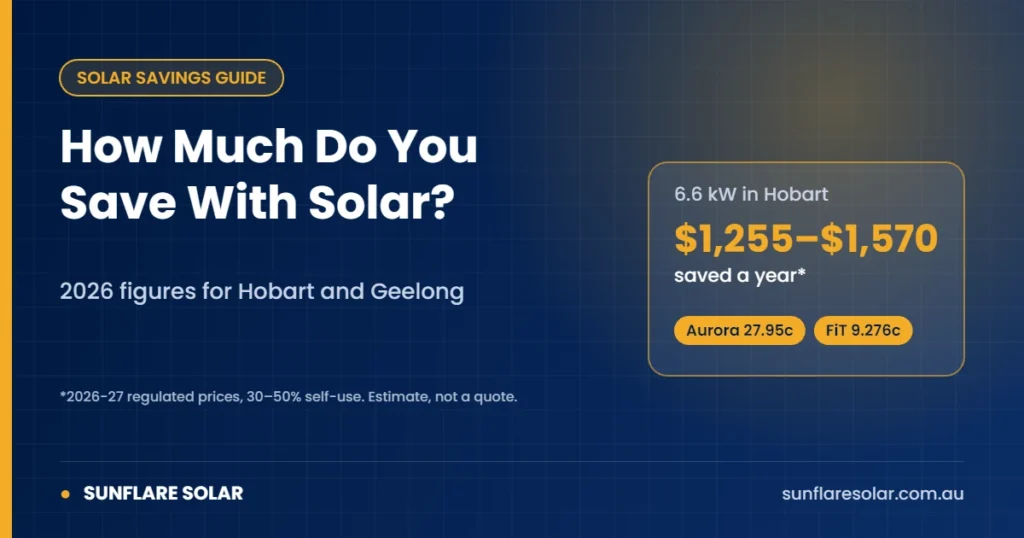
The short answer: a typical 6.6 kW solar system in Hobart saves roughly $1,250 to $1,570 a year on a flat-rate Aurora plan, and about $730 to $1,220 a year in Geelong on the Victorian Default Offer, before any feed-in credits from your retailer. The biggest factor is not the size of the system. It is how much of the solar power you use yourself, because every kilowatt-hour you use saves you the full grid price, while every kilowatt-hour you export earns a much smaller feed-in credit.
Below we show the simple formula, the 2026-27 prices we used and two worked examples, so you can check the numbers against your own power bill. For a quick estimate for your home, try our solar panel calculator.
The simple formula
Yearly saving = (solar you use yourself × your usage rate) + (solar you export × your feed-in tariff).
So you need three numbers: how much your panels produce, how much of that you use in the house, and the two prices on your bill (the usage rate and the feed-in tariff). The rest of this guide fills in each one.
Step 1: How much power your panels make
The Clean Energy Council publishes average daily output figures for each capital city, per kilowatt of panels. A well-installed system should produce within about 90% of these figures over a year.
| City | Per kW per day | 6.6 kW system | 10 kW system |
|---|---|---|---|
| Hobart | 3.5 kWh | about 23 kWh a day (8,430 a year) | about 35 kWh a day (12,775 a year) |
| Melbourne / Geelong | 3.6 kWh | about 24 kWh a day (8,670 a year) | about 36 kWh a day (13,140 a year) |
| Sydney | 3.9 kWh | about 26 kWh a day | about 39 kWh a day |
| Perth | 4.4 kWh | about 29 kWh a day | about 44 kWh a day |
These are yearly averages. In Hobart, winter output is much lower than the average and summer output much higher, so a bill in July will look very different from a bill in January. Your roof direction, tilt and shade also change the result, which is why we check them at the free assessment before sizing a system.
Step 2: What each kilowatt-hour is worth
Every unit of solar you use yourself replaces a unit you would have bought from the grid. Every unit you do not use goes back to the grid and earns the feed-in tariff. These are the 2026-27 regulated prices we used:
| Usage rate (you save this) | Feed-in tariff (you earn this) | |
|---|---|---|
| Tasmania (Aurora Energy, Tariff 31 light and power) | 27.95c per kWh | 9.276c per kWh (regulated minimum) |
| Victoria, Powercor area incl. Geelong (Victorian Default Offer, flat) | 28.22c per kWh | No minimum: set by each retailer |
In Tasmania a kilowatt-hour you use is worth about three times a kilowatt-hour you export. In Victoria the gap is even bigger, because the state stopped setting a minimum feed-in tariff from 1 July 2025 and many retailers now pay very little. That is why using your own solar matters so much.
Worked example: 6.6 kW in Hobart
Assumptions: 8,430 kWh a year from the panels, Aurora flat rate 27.95c, feed-in 9.276c. The only thing we change is the share of solar used in the house.
| Share of solar you use | Saved on your bill | Feed-in credits | Total a year |
|---|---|---|---|
| 30% (out at work all day) | $707 | $547 | about $1,255 |
| 50% (someone home, timers on appliances) | $1,178 | $391 | about $1,570 |
| 80% (with a home battery) | $1,886 | $156 | about $2,040 |
A 10 kW system in Hobart with 50% self-use works out at about $2,380 a year on the same prices. Bigger is only better if you can use or store the extra power: exported solar earns about a third of what it saves when used.
Worked example: 6.6 kW in Geelong
Assumptions: 8,670 kWh a year, Powercor flat rate 28.22c on the Victorian Default Offer, and no feed-in credit (to keep the numbers safe, as rates vary by retailer).
| Share of solar you use | Saved on your bill | Feed-in credits | Total a year |
|---|---|---|---|
| 30% | $734 | depends on retailer | about $734 plus credits |
| 50% | $1,224 | depends on retailer | about $1,224 plus credits |
| 80% (with a home battery) | $1,958 | depends on retailer | about $1,958 plus credits |
Each 1c per kWh your retailer pays for exports adds about $61 a year in the 30% case. If you are on a time-of-use plan, the evening peak rate (41.67c per kWh in the Powercor area from 4pm to 9pm) is where a battery earns the most. See home batteries in Geelong for the full Victorian picture.
What makes your saving bigger or smaller
- When you use power. Running the dishwasher, washing machine, pool pump or hot water heat pump in the middle of the day turns cheap exports into full-price savings.
- Your tariff. Flat rates, time-of-use rates and feed-in tariffs all change the maths. Check the plan on your bill before comparing quotes.
- Roof direction and shade. North-facing panels with no shade produce the most. East-west roofs produce a little less in total but spread it over the day.
- Season. In Tasmania, winter output can be less than half of the yearly average, so judge savings over a full year, not one bill.
- System size versus your usage. A system much bigger than your daytime use mostly earns feed-in credits.
Adding a battery
A battery stores midday solar for the evening, which moves units from “exported for a few cents” to “used for the full rate”. In the Hobart example, going from 30% to 80% self-use adds about $790 a year. The federal Cheaper Home Batteries rebate is taken off the battery price upfront, but the rebate rate per kWh drops on 1 January 2027, so the install date matters. See what changes on 1 January 2027 and solar batteries in Tasmania.
The upfront rebate on the panels
The federal solar rebate comes as small-scale technology certificates (STCs), taken off your quote by the installer. For a 6.6 kW system installed in Hobart or Geelong in 2026 that is 39 certificates. Certificates have traded close to the $40 clearing house price, so the discount is roughly $1,500 to $1,560. The number of certificates falls each year until the scheme ends in 2030.
How to work out your payback
Payback in years = the price on your quote ÷ your yearly saving. Use the yearly saving for the share of solar you realistically expect to use, not the best case. Every good quote should show the system size, the STC discount, the expected yearly output and the assumptions behind any saving figure. Our guide on how to compare solar quotes lists what to check.
Want numbers for your own roof and bill? Use the solar panel calculator, or book a free assessment for solar panels in Hobart or solar panels in Geelong. You can also see real installs with system sizes, like this Kingston solar and battery job.
Running a business? See commercial solar in Hobart and Launceston for business tariffs, STCs for larger systems and worked examples.
Frequently asked questions
How much does a 6.6 kW solar system save in Hobart?
On 2026-27 Aurora flat-rate prices (27.95c per kWh) and the 9.276c feed-in tariff, a 6.6 kW system producing about 8,430 kWh a year saves roughly $1,255 a year if you use 30% of the solar, and about $1,570 if you use half of it.
How much does solar save in Geelong?
On the 2026-27 Victorian Default Offer flat rate for the Powercor area (28.22c per kWh), a 6.6 kW system saves about $730 a year at 30% self-use and about $1,220 at 50%, plus any feed-in credit your retailer pays.
Is it better to use my solar or export it?
Using it. In Tasmania a kilowatt-hour you use is worth about three times one you export. In Victoria there is no minimum feed-in tariff, so the gap can be even larger.
Does a battery increase my savings?
Usually, because it lets you use more of your own solar in the evening. In our Hobart example, moving from 30% to 80% self-use adds about $790 a year. The battery rebate rate drops on 1 January 2027.
Sources: Clean Energy Council average daily output figures (via SolarQuotes); Aurora Energy 2026-27 residential tariffs; Office of the Tasmanian Economic Regulator, feed-in tariff 2026-27; Essential Services Commission, Victorian Default Offer 2026-27 and minimum feed-in tariff; Clean Energy Regulator, STC market reports. Figures checked 23 November 2026. Examples are estimates for comparison, not a quote.